In 2025, Nigeria’s international trade framework underwent notable regulatory and operational shifts driven by accelerated customs modernisation and broader economic adjustment. Key developments included the launch of the Nigeria Customs Service Authorised Economic Operator (AEO) Programme, the phased migration from the Fast Track Scheme, expanded deployment of the Unified Customs Management System (B’Odogwu), and intensified preparations for the National Single Window as the backbone of trade facilitation reform1. These reforms unfolded against a backdrop of exchange-rate realignment, inflationary pressure, and fiscal consolidation, alongside renewed policy emphasis on non-oil exports and regional market integration under the AfCFTA2. Together, these factors defined the immediate operating context for Nigeria’s trade regime entering 20263.
In the year 2026, it is expected that Nigeria’s international trade landscape will be shaped by the convergence of three decisive forces. The first is the pace and effectiveness of customs-led trade facilitation and port reforms, particularly the rollout of the National Single Window, expansion of the Authorised Economic Operator (AEO) programme, increased use of advance rulings, and the Nigeria Customs Service’s transition toward technology-driven, risk-based controls aimed at reducing cargo dwell time and human interface4.
The second is the state of macro-economic fundamentals, including exchange-rate stability, inflation, oil production and pricing assumptions, together with fiscal pressures, all of which directly affect import costs, customs valuation, trade volumes, and the competitiveness of Nigeria’s non-oil exports5.
The third is Nigeria’s positioning within regional and global trade frameworks, particularly the practical implementation of the African Continental Free Trade Area (AfCFTA), ECOWAS transit and corridor reforms, evolving global supply-chain realignments, and increasing regulatory pressures such as sustainability-linked trade measures6. The interaction of these factors will determine whether 2026 delivers tangible reductions in the cost of trading across Nigeria’s borders or whether reform gains are constrained by macroeconomic and external headwinds7.
Nigeria’s international trade performance in the immediate pre-2026 period reflects both resilience and structural constraint. According to official trade statistics published by the National Bureau of Statistics (NBS), Nigeria recorded total merchandise trade values of approximately 74.8 trillion in 2024, driven largely by crude oil exports, while non-oil exports continued to account for a comparatively modest share of total export earnings8. Provisional 2025 data indicate a marginal increase in overall trade value, supported by higher export receipts and sustained import demand for manufactured goods, machinery, and refined petroleum products, albeit within a volatile foreign-exchange environment9.
Looking ahead to 2026, trade volumes are expected to be shaped less by absolute demand and more by cost efficiency, regulatory predictability, and logistics performance. The combined effect of customs digitalisation, port reforms, AfCFTA utilisation, and macroeconomic stabilisation measures suggests moderate growth in non-oil exports and more disciplined import patterns, particularly among manufacturers and traders able to leverage trade facilitation programmes and regional market access10.
Authorised Economic Operator (AEO): Consolidation of Trusted Trader Regime in 2026
A central pillar of Nigeria’s trade facilitation framework in 2026 will be the consolidation of the Authorised Economic Operator (AEO) Programme as the primary trusted-trader regime administered by the Nigeria Customs Service11. Following its formal launch in February 2025 in line with World Customs Organization (WCO) standards, the programme has moved beyond pilot status and is entering a national scale-up phase designed to embed compliance-based differentiation within customs processing12.
A defining inflection point for 2026 is the mandatory migration of eligible operators from the legacy Fast Track Scheme to the AEO framework, with the Nigeria Customs Service extending the migration deadline to 31 January 2026 to allow traders complete onboarding and documentation requirements13. This transition reflects a deliberate policy shift away from discretionary facilitation toward a rules-based, audit-driven model grounded in supply-chain security, internal compliance systems, and post-clearance accountability, consistent with the WCO SAFE Framework and the WTO Trade Facilitation Agreement14.
In practical terms, AEO-certified operators in 2026 are expected to benefit from priority treatment, reduced inspection rates, and greater predictability, while simultaneously being subject to heightened compliance expectations, continuous monitoring, and potential suspension or revocation of benefits for non-conformity—thereby reshaping both operational risk and the scope of customs-related advisory and dispute resolution work15.
National Single Window (NSW): Institutionalising Coordinated Border Management
Closely following the AEO regime, the operationalisation of Nigeria’s National Single Window (NSW) represents the most consequential structural reform influencing trade administration in 2026. Though long on the drawing board since 2012, the NSW followed Nigeria’s commitment to the Trade Facilitation Agreement and subsequent introduction under the Nigeria Customs Service Act16.
It is designed as a centralised digital platform linking the Nigeria Customs Service with all border regulatory agencies to enable single-point submission of trade data, eliminate duplicative procedures, and improve transparency across clearance processes171717. Official policy statements indicate that phase-one implementation is targeted for the first quarter of 2026, with the reform anchored on reducing cargo clearance time, strengthening inter-agency coordination, and limiting discretionary human intervention at ports and borders18.
If effectively implemented, the NSW will recalibrate compliance obligations for traders by shifting regulatory focus toward data accuracy, pre-arrival processing, and system-based risk management, while also expanding the scope for administrative review and inter-agency accountability in cases of delay, system failure, or conflicting regulatory demands19.
Ports, Logistics, and Corridor Efficiency
In 2026, the effectiveness of Nigeria’s trade reforms will be tested not only at the level of customs clearance but across the wider ports and logistics ecosystem, where delays continue to operate as a significant hidden tariff on trade20. The coordinated border management, port process reforms, and digital clearance systems are Government policies aimed at reducing cargo dwell time and bringing average clearance timelines closer to international benchmarks21. However, structural constraints relating to port access, truck congestion, inland haulage, and corridor governance, particularly within the Lagos port complex, remain critical risk factors for trade cost predictability22.
The sustainability of initiatives such as the electronic call-up system and broader port community coordination will therefore be decisive in determining whether gains achieved through customs digitalisation translate into tangible reductions in logistics costs for importers, exporters, and investors in 2026 and beyond23.
A significant trade reform taking full effect in 2026 is the abolition of the traditional container deposit system under Nigeria’s new container insurance framework24. Section 203 of the Nigerian Insurance Industry Reform Act 2025 (NIIRA) prohibits shipping lines from collecting refundable cash deposits from importers and agents as security for container returns, replacing this practice with a mandatory container insurance regime to be provided by licensed Nigerian insurers25.
The reform delivers an immediate liquidity benefit for trade operators by substituting large upfront deposits with premium-based insurance coverage, supported by a collective container insurance bond reportedly arranged by NACCIMA and domestic insurers. However, compliance obligations are now stricter26. Non-compliance attracts a minimum fine of 1 million upon conviction, and the regime is designed to integrate with the National Single Window and port clearance systems, exposing non-compliant operators to clearance delays and regulatory sanctions. Accordingly, importers and agents must review carrier agreements and ensure insurance documentation and digital systems are fully aligned with regulatory requirements27272727.
AfCFTA and Regional Trade Integration
Regional trade integration under the African Continental Free Trade Area (AfCFTA) will increasingly shape Nigeria’s trade environment in 2026 as implementation shifts from legal commitments to operational utilisation28. Nigeria’s participation in the AfCFTA Guided Trade Initiative and the alignment of its tariff schedule through the ECOWAS Common External Tariff framework signal a gradual move toward preferential market access for qualifying goods29.
However, the practical impact of AfCFTA in 2026 will depend on the effectiveness of customs cooperation, transit regimes, and rules-of-origin administration, particularly along Nigeria’s land borders30. Initiatives such as customs interconnectivity and regional transit monitoring systems are therefore critical to reducing border friction and enabling Nigerian manufacturers and exporters to competitively access regional value chains31. We look forward to the greater gains in market accessibility across Africa in 2026.
Macroeconomic and Foreign-Exchange Dynamics
Macroeconomic conditions such as exchange-rate stability, inflation, and access to foreign exchange will remain decisive for Nigeria’s international trade performance in 2026. While recent policy adjustments have moved toward a more market-reflective exchange-rate framework, residual volatility continues to affect import pricing, customs valuation, trade finance availability, and working-capital planning for traders32.
Elevated inflation and tight monetary conditions further compound trade costs by increasing logistics, insurance, and financing expenses, with disproportionate impact on small and medium-sized importers and exporters33. Consequently, the extent to which macroeconomic reforms translate into relative FX predictability and improved liquidity will materially influence trade volumes, non-oil export competitiveness, and investor confidence across Nigeria’s external sector in 202634.
External Regulatory and Geopolitical Pressures
Nigeria’s trade environment in 2026 will also be shaped by external regulatory developments and geopolitical risks that influence market access, freight costs, and supply-chain reliability35. Of particular relevance is the European Union’s Carbon Border Adjustment Mechanism (CBAM), which enters its definitive phase in 2026 and introduces carbon-cost exposure for covered products exported into the EU, with indirect compliance implications for Nigerian suppliers integrated into EU-linked value chains36.
In parallel, ongoing geopolitical tensions affecting major shipping corridors, including the Red Sea and Suez routes, continue to generate volatility in freight rates, transit times, and marine insurance costs, with downstream effects on landed prices for Nigerian imports and exports37. These external pressures underscore the growing intersection between trade regulation, sustainability standards, and geopolitical risk management, requiring Nigerian traders and investors to factor non-tariff and extra-jurisdictional constraints more prominently into their 2026 trade strategies38.
Non-Oil Exports, Industrial Policy, and Value Addition
In 2026, Nigeria’s trade performance will increasingly depend on the depth and resilience of its non-oil export base, shaped by an evolving industrial policy that prioritises local processing and value addition over raw commodity exports39. Recent policy measures including targeted export controls on selected raw materials and the continued use of incentive schemes such as the Export Expansion Grant (EEG) signal a strategic effort to retain value within domestic supply chains, improve export earnings, and support manufacturing employment. While these measures offer opportunities for agro-processing and light manufacturing, their trade impact will hinge on regulatory clarity, consistency in incentive administration, and the availability of trade-enabling infrastructure and finance40. In this context, 2026 is likely to test Nigeria’s ability to balance export promotion with regulatory intervention in a manner that remains compliant with regional and multilateral trade obligations41.
Expectations and Strategic Implications
The interaction of customs reform, logistics constraints, macroeconomic conditions, regional integration efforts, and external regulatory pressures suggests that 2026 will be a transitional but decisive year for Nigeria’s international trade regime42. While ongoing digitisation and trade facilitation initiatives promise greater predictability and reduced procedural friction, their effectiveness will depend on complementary improvements in port logistics, FX stability, and regulatory coordination across agencies43.
At the same time, expanding regional trade opportunities under the AfCFTA and rising sustainability-linked trade requirements will require Nigerian traders and investors to adopt more sophisticated compliance, documentation, and risk-management strategies44. For policymakers and market participants alike, 2026 is therefore likely to test whether Nigeria’s reform momentum can translate into durable competitiveness, deeper integration into regional and global value chains, and improved ease of trading across its borders45.
References
- World Customs Organization (WCO), Nigeria Launches Authorised Economic Operator (AEO) Programme (2025).
- Nigeria Customs Service, official communications on trade facilitation reforms. Nigeria Customs Service, stakeholder briefings and policy statements on the Unified Customs Management System (B’Odogwu) and National Single Window preparatory framework (2024-2025).
- International Monetary Fund (IMF), Nigeria: Article IV Consultation and World Economic Outlook updates (2024-2025).
- AfCFTA Secretariat, Guided Trade Initiative Progress Reports; Federal Government of Nigeria, policy statements on non-oil exports and regional trade integration (2025).
- World Customs Organization (WCO), Nigeria Launches Authorised Economic Operator (AEO) Programme (2025); Nigeria Customs Service, Trade Facilitation Reforms and Digitalisation Agenda (official communications).
- National Bureau of Statistics (Nigeria), ‘Foreign Trade in Goods Statistics’ (NBS Quarterly Reports, 2024).
- Federal Government of Nigeria, National Single Window Programme Framework; Nigeria Customs Service, statements on National Single Window implementation and clearance-time reduction targets.
- National Bureau of Statistics (Nigeria), ‘Foreign Trade in Goods Statistics’ (NBS Provisional Data, 2025).
- International Monetary Fund, ‘Nigeria: Article IV Consultation’ (IMF Country Report, 2025); World Bank, Nigeria Development Update (World Bank, Washington DC).
- Nigeria Customs Service, Announcement on Extension of Deadline for Migration from Fast Track Scheme to the Authorised Economic Operator (AEO) Programme (official communication, 2025); Federal Ministry of Information and National Orientation, press release on AEO migration extension.
- World Customs Organization, SAFE Framework of Standards to Secure and Facilitate Global Trade; World Trade Organization, Trade Facilitation Agreement, arts 7.7 and 7.8.
- Nigeria Customs Service, AEO Programme Guidelines and stakeholder briefings on compliance obligations, benefits, and post-clearance audit mechanisms.
- Nigeria Customs Service Act 2023, s 33.
- Federal Government of Nigeria, National Single Window Programme Framework; Nigeria Customs Service, policy statements on Coordinated Border Management and trade digitalisation.
- Nigeria Customs Service, official communications and stakeholder briefings on National Single Window rollout timeline (2024-2025).
- World Trade Organization, Trade Facilitation Agreement, arts 8 and 10; World Customs Organization, Coordinated Border Management: A Practical Guide.
- Federal Government of Nigeria, Presidential Enabling Business Environment Council (PEBEC): Port Process Reforms and Cargo Dwell Time Reduction Initiatives (Policy Statements and Implementation Updates, 2023-2025); Nigeria Customs Service, Coordinated Border Management and Trade Facilitation Reforms (Official Communications and Stakeholder Briefings, 2024-2025).
- Nigerian Ports Authority (NPA), Port Operations and Performance Reports (Lagos Ports Complex and Tin Can Island Port, 2023-2025); Nigerian Ports Authority, Stakeholder Engagements on Truck Congestion, Port Access Roads, and Infrastructure Constraints (Official Briefings).
- World Bank Group, Doing Business 2020: Trading Across Borders (World Bank, Washington DC 2020); Nigerian Ports Authority, Electronic Call-Up System (E-Call-Up) for Port Access: Operational Updates and Port Community Coordination Measures (Official Publications and Press Releases).
- Nigerian Insurance Industry Reform Act 2025, s 203.
- Nigerian Association of Chambers of Commerce, Industry, Mines and Agriculture (NACCIMA), ‘Press Statement on the National Container Insurance Scheme (2025).
- AfCFTA Secretariat, Guided Trade Initiative: Operational Update; Federal Ministry of Industry, Trade and Investment, statements on Nigeria’s AfCFTA tariff schedule and implementation.
- World Trade Organization, Trade Facilitation Agreement, art 11; ECOWAS Commission, Customs and Transit Facilitation Instruments.
- Nigeria Customs Service, statements on regional customs cooperation and transit monitoring initiatives; ECOWAS Commission, programmes on customs interconnectivity and trade facilitation.
- International Monetary Fund, Nigeria: Article IV Consultation-Staff Report (IMF Country Report, 2024-2025).
- Central Bank of Nigeria, Monetary Policy Committee Communiqué (various editions, 2024-2025); World Bank, Nigeria Development Update: Macroeconomic Stability and Trade Implications (World Bank 2024).
- Federal Ministry of Finance, Medium-Term Expenditure Framework and Fiscal Strategy Paper 2026-2028 (Government of the Federal Republic of Nigeria, Abuja).
- European Commission, Carbon Border Adjustment Mechanism: Transitional Phase and Definitive Application from 2026 (EU Commission Guidance and Implementing Regulations, 2023-2025).
- United Nations Conference on Trade and Development (UNCTAD), Global Trade Update: Shipping Disruptions and Trade Costs (UNCTAD 2024); International Maritime Organization, Impact of Maritime Security Risks on Global Shipping (IMO Reports).
- World Trade Organization, World Trade Report: Trade and Sustainability (WTO 2024); Organisation for Economic Co-operation and Development (OECD), Global Value Chains and Trade Policy Risks (OECD Publishing 2023).
- Federal Ministry of Industry, Trade and Investment, National Trade Policy and Industrial Policy Measures on Export Development (Government of the Federal Republic of Nigeria, Abuja); Federal Government of Nigeria, policy statements on restrictions affecting exports of unprocessed commodities.
- Nigerian Export Promotion Council (NEPC), Export Expansion Grant (EEG) Guidelines and Implementation Framework (NEPC Publications, Abuja).
- World Trade Organization, General Agreement on Tariffs and Trade 1994 (GATT 1994) arts XI and XX; African Continental Free Trade Area Agreement, Protocol on Trade in Goods.
- World Trade Organization, Trade Facilitation Agreement, World Customs Organization, Measuring the Impact of Trade Facilitation Reforms (WCO Research Papers).
- African Continental Free Trade Area Secretariat, State of AfCFTA Implementation Report, World Trade Organization, World Trade Report: Trade and Sustainability (WTO 2024).



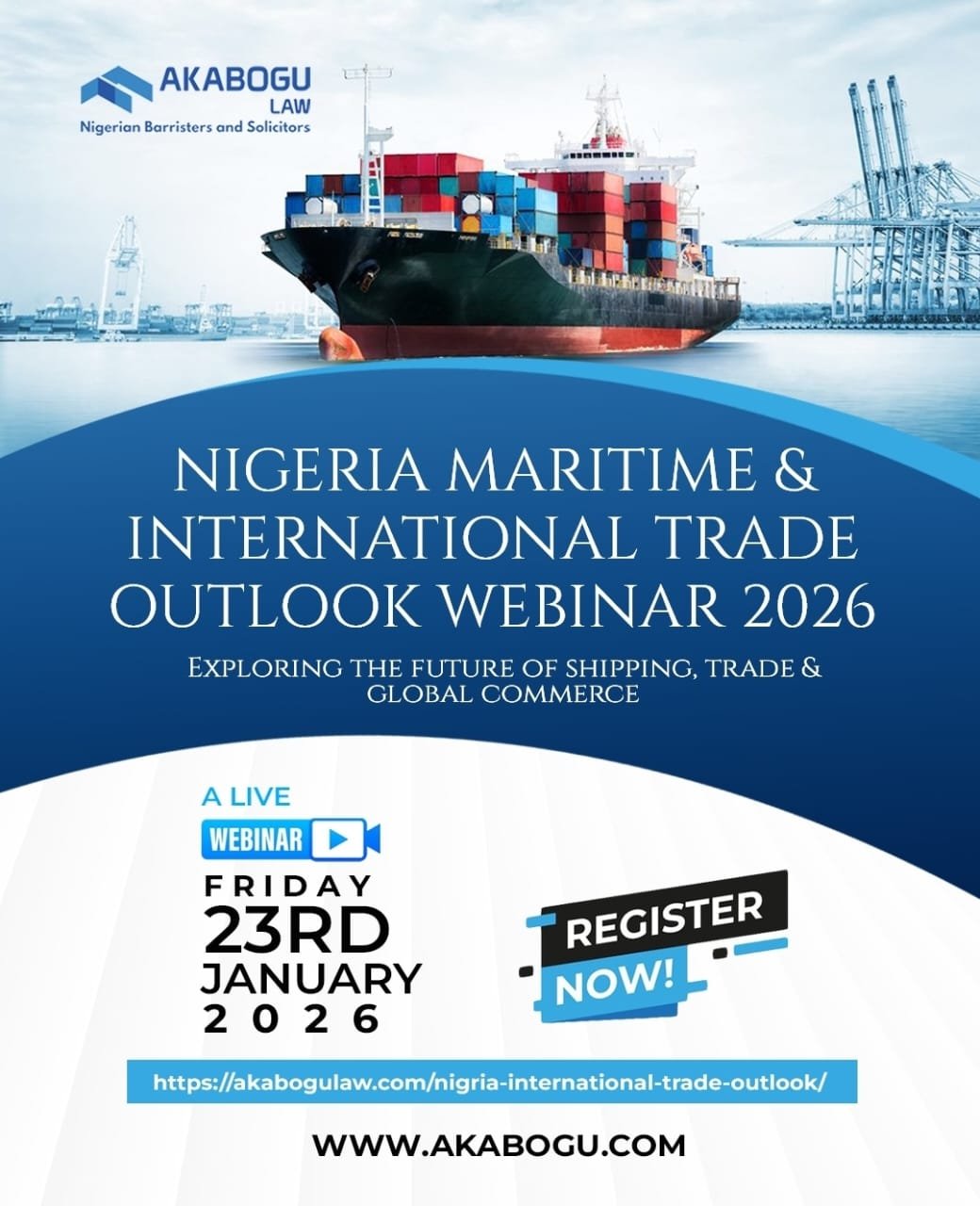
In 2026, Nigeria’s trade environment will be defined by the interaction of digital customs reforms, macroeconomic fundamentals, and regional integration. Join us as we unpack the three decisive forces converging to reshape International and Maritime trade in Nigeria.