Navigating Ship Collision Claims Under Nigerian Maritime Law
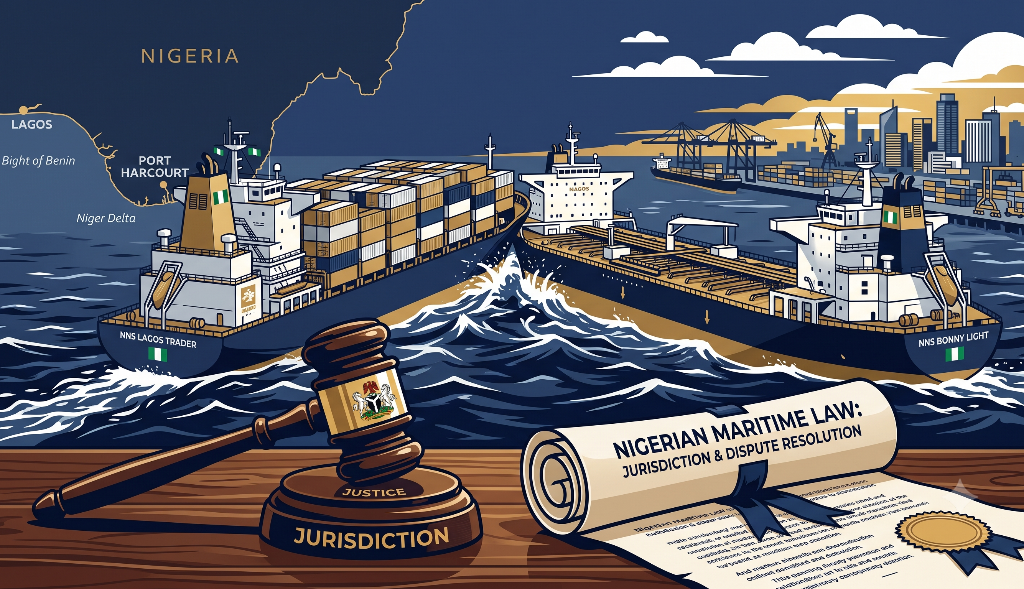
– By Samuel Dele Orofin
1. Introduction and Definition
Ship collision, also called maritime or vessel collision, is one of the most consequential risks in the maritime industry, with significant legal, financial, and environmental implications. As Nigeria’s port traffic continues to grow, the frequency and complexity of collision incidents have increased correspondingly.
Under Nigerian law, a collision is defined broadly: it encompasses any accident involving two or more vessels that causes loss or damage, even where no actual physical contact occurs.[1] Collision may also occur between a vessel and a fixed or floating structure such as an offshore platform or port installation.
2. Legal Framework
2.1 Domestic Legislation
The primary statute is the Merchant Shipping Act 2007, which governs liability, assessment of damages, and the rights of claimants and defendants in collision matters. The NIMASA Act 2007 plays a complementary role, empowering the Nigerian Maritime Administration and Safety Agency to enforce safety standards and international conventions ratified by Nigeria.[2]
2.2 International Conventions
Nigeria is bound by the International Regulations for Preventing Collisions at Sea 1972 (COLREGS), which prescribe rules on look‑out duties,[3] safe speed,[4] right of way, conduct in restricted visibility,[5] and vessel lighting.[6] Breach of COLREGS is frequently the basis for establishing negligence. The International Convention on Limitation of Liability for Maritime Claims (LLMC) and the Civil Liability Convention (CLC) are also relevant where shipowners seek liability limitation or where oil pollution follows a collision.
2.3 Common Law
Nigerian courts apply common law principles of negligence, duty of care, and causation in collision disputes, drawing on English admiralty jurisprudence given the shared legal heritage in admiralty matters.
3. Causes and Consequences
3.1 Common Causes
- Human error — the predominant cause globally; includes failure to maintain proper look‑out, fatigue, miscommunication, and misjudgement of course or speed.
- Failure to comply with COLREGS — breaches of navigational rules (e.g. failure to yield right of way, improper lighting, failure to sound signals).
- Extreme weather — fog, strong currents, tropical storms, and reduced visibility.
- Equipment failure — malfunction of radar, AIS, GPS, or steering gear.
- Inadequate crew training and certification.
- Port and waterway congestion, particularly in high‑traffic areas like Lagos.
- Failure of Vessel Traffic Services (VTS) to provide timely navigational guidance.
3.2 Key Consequences
- Loss of human and aquatic life.
- Structural damage to vessels (minor hull breaches to total loss).
- Environmental pollution — oil spills and cargo leakage endangering marine ecosystems.
- Enormous financial liability — repair/replacement costs, salvage, clean‑up, and litigation.
- Damage to port infrastructure (jetties, buoys, quay walls).
- Trade disruption, cargo delay, and consequential demurrage and detention claims.
- Reputational damage to shipowners, operators, and charterers.
4. Liability
Vessel operators are legally required to observe established safety precautions.[7] Failure to do so may give rise to both civil liability and criminal sanctions.[8]
4.1 Assessment of Damages
Under the Merchant Shipping Act, a claimant may only recover damages that are the direct and immediate consequence of the collision.[9] The aim is to restore the claimant to the financial position they would have occupied had the collision not occurred. The burden of proof lies on the claimant, and damages are reduced to the extent that the claimant could have mitigated their loss.[10] Recovery may cover vessel replacement or repair costs;[11] for cargo claims, the market or shipped value of lost or damaged goods.[12]
Interest is recoverable at ten per cent per annum under section 350(4) of the MSA. (Note: In practice, Nigerian courts often award interest from the date of filing the action rather than from the dates specified in the statute.)
4.2 Apportionment of Fault
Where both vessels are found negligent or in breach of navigational rules, liability is apportioned between them according to their respective degrees of fault. This principle of contributory negligence is well‑established in Nigerian maritime jurisprudence.
4.3 Limitation of Liability
Under the Merchant Shipping Act 2007, which gives domestic effect to the Convention on Limitation of Liability for Maritime Claims (LLMC) 1976 and its 1996 Protocol pursuant to section 351, a shipowner may limit liability to a fixed sum calculated on the vessel’s tonnage. The right to limit is lost only where it is shown that the loss resulted from the owner’s personal intentional or reckless act with knowledge that such loss would probably result.
5. Dispute Resolution
5.1 Litigation
The Federal High Court of Nigeria exercises exclusive jurisdiction over admiralty matters, including collision claims, by virtue of the Admiralty Jurisdiction Act 1991 and the Federal High Court Act.[13] Claims may be brought in rem (against the vessel itself) or in personam (against the owner or operator).
5.2 Vessel Arrest
A collision claimant may apply ex parte to arrest the offending vessel as security for the claim pending resolution. The vessel is released upon provision of adequate security — typically a P&I Club Letter of Undertaking or a bank guarantee. Given the transient nature of vessels, arrest is a particularly important remedy in Nigerian admiralty practice.
5.3 Alternative Dispute Resolution
Collision disputes may also be resolved through arbitration, where maritime contracts so provide, mediation, or negotiated settlement. Foreign arbitral awards are enforceable in Nigeria under the Arbitration and Mediation Act 2023, which gives effect to the New York Convention.
6. Conclusion
Nigeria’s legal framework — spanning the MSA 2007, COLREGS, relevant international conventions, and the admiralty jurisdiction of the Federal High Court — provides a reasonably comprehensive basis for the determination and enforcement of collision claims. Nonetheless, prevention remains the most desirable outcome. Strict compliance with navigational rules, investment in modern technology, adequate crew training, and effective port management are essential to reducing collision incidents in Nigerian waters. Where disputes are unavoidable, parties should explore ADR mechanisms before resorting to litigation.
Footnotes
[1] Collision means any accident involving two or more vessels which causes loss or damage even if no actual contact has taken place; (s. 336(6), Merchant Shipping Act 2007 (“MSA 2007”)).
[2] NIMASA Act 2007, S22(1)(d) established maritime training and safety standards; (e) regulate the safety of shipping as regards the construction of ships and navigation.
[3] Every vessel shall at all times maintain a proper look‑out by sight and hearing as well as by all available means appropriate in the prevailing circumstances and conditions so as to make a full appraisal of the situation and of the risk of collision; Rule 5, 1972 CONVENTION ON THE INTERNATIONAL REGULATIONS FOR PREVENTING COLLISIONS AT SEA.
[4] Every vessel shall at all times proceed at a safe speed so that she can take proper and effective action to avoid collision and be stopped within a distance appropriate to the prevailing circumstances and conditions; Rule 6, id.
[5] Rule 19, id.
[6] The Rules concerning lights shall be complied with from sunset to sunrise, and during such times no other lights shall be exhibited, except such lights as cannot be mistaken for the lights specified in these Rules or do not impair their visibility or distinctive character, or interfere with the keeping of a proper look‑out; Rule 20, id.
[7] S. 217, MSA 2007.
[8] S. 218, MSA 2007 — Any person who fails to comply with and does or attempts to do any act contrary to the provisions of any safety regulations made under section 217 of this Act commits an offence and is liable on conviction to a fine not less than three hundred thousand naira.
[9] S. 344, MSA 2007 (providing that damages must be the direct and immediate consequence of the collision).
[10] S. 346, MSA 2007 — The burden of proving the loss or damage sustained in accordance with the provisions of this Act shall be upon the claimant and damages shall not be recoverable to the extent that the person against whom the claim is made is able to show that the claimant could have avoided or mitigated the loss or damage by the exercise of reasonable diligence.
[11] S. 348, MSA 2007 — “Where a vessel is damaged but not in total loss as defined in this Part of this Act, the claimant shall be entitled to recover as damages — (a) the cost of temporary repairs reasonably effected, and the reasonable cost of permanent repairs.”
[12] S. 349, MSA 2007 — The claimant shall be entitled to recover damages when property has been lost or damaged in consequence of the collision.
[13] AJA Cap. A5, Laws of the Federation of Nigeria, 2004 S. 2(3) — A reference in this Act to a general maritime claim is a reference to — (a) a claim for damage done by a ship, whether by collision or otherwise.